BOD Group Innovation Centre Launches Energy Storage Manufacturing
The Global BOD Group’s Innovation Centre, generally designed by BE LIVE, has officially opened its doors. The first of its kind in Lithuania, a solar-powered smart battery named Nova, was introduced at the event.
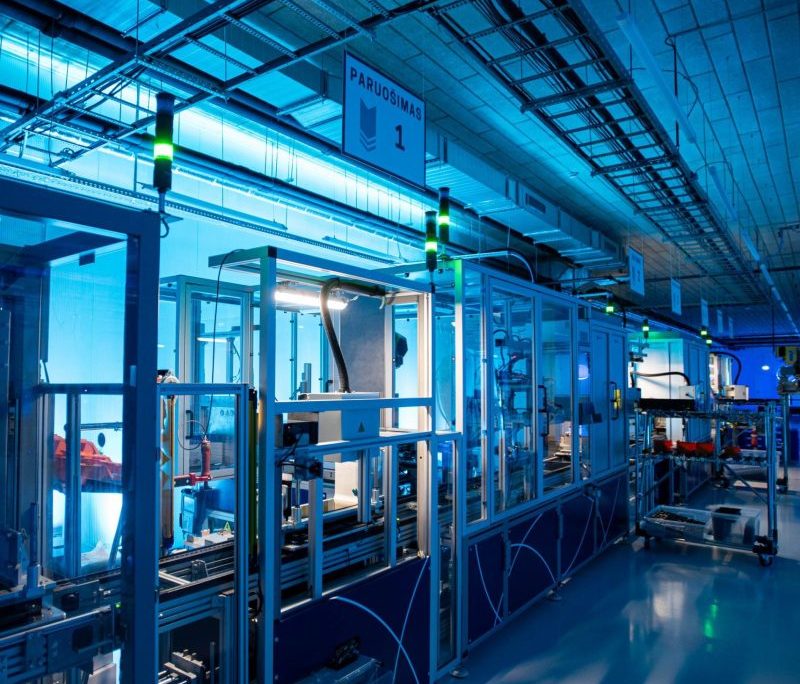
Julius Sakalauskas, the CEO of SoliTek, the company behind the manufacturing of these storage devices, shared that the Nova battery can store up to 40 kilowatt-hours (kWh) of energy. This makes it one of the most high-capacity energy storage devices available in the market. He further revealed that the production line is projected to manufacture 0.35 gigawatt-hours (GWh) of batteries annually. With the addition of another line, the capacity is expected to increase to 1.5 GWh in the coming years.
The President of the Republic of Lithuania, Gitanas Nausėda, graced the opening of the new Innovation Centre. He emphasized that the centre’s inauguration symbolizes the dawn of a new era for Lithuania’s economy, one that is driven by innovation and science. He expressed his belief that the centre will be the birthplace of numerous valuable discoveries and inventions. The President also highlighted that the Business and Innovation Centre, which operates autonomously and is fully powered by green energy, has already set a new standard for construction technologies and serves as a model for the entire Lithuanian industry.
Darius Kvedaras, the CEO of the BE LIVE group of companies, stated that the building will make history as it is the first in the region to be entirely self-sufficient in terms of energy, generating all its required energy from solar and geothermal sources.
“The Global BOD Group Innovation Centre signifies a new stage of genuine energy independence for buildings. This is not an experiment or a compromise, but a tangible contribution to energy independence in multiple dimensions,” said the CEO of BE LIVE.

The Global BOD Group Innovation Centre spans over 32,000 square meters, featuring six floors with terraces and a basement. It houses research, production, office, medical, and warehouse facilities. The building operates independently of the city’s central heating system, utilizing geothermal heating and solar power for its heating and cooling needs. The electricity supply is solely for additional production functions.
The building integrates more than 850 kW of solar modules on its roof and facade. Heating and cooling are facilitated by 720 kW of heat pumps, with four 180 kW heat pumps installed. The heating system also functions as a cooling loop, keeping the building cool during the summer.
Plans are in place for a 3.3 MWh electricity storage system to ensure the building’s independence from any electricity price fluctuations and, if necessary, to enable the building’s autonomous operation for up to a month without an external electricity supply.
During winter, the building can maintain its heating even if the power supply is disrupted for more than a week. In the summer, full autonomy can be sustained significantly longer.
